Monday, 22 July 2013

Message from Home


I've been seizing up. Overwhelmed. Seeking space, quiet, a place to pause. A place to breathe.


 I have felt vulnerable and my skin tingly. I don't know why. Yet I do in a way. It's the not feeling enough to go around for everyone that needs me. It's the frayed edge at the end of the day. It's the small intricate details that merge and surge like snow drifts or dunes against the soul.
I need my eye to gaze unhindered for a moment upon these pictures. The silver blue, distance, immense as a whale and as unfathomable.


I intentionally got out my sketchbooks and some beautiful thick, charcoal pencils this afternoon. Tani took the girls out for an hour and I made a cinnamon tea, as you must on grey, rainy Summer days, and I sketched, away. letting the graphite line take me on a journey.


Sometimes, the first thing we look for is a distraction when the best thing to do is sit with the feelings and ask them what story they are trying to tell.


Meaning, is found in relationship.
Relationships develop through listening.
So I am being quiet.


I love how children just are. I love their freedom to be authentically in the moment. No social constructs, no ideology, no scaffolding to hold their identity up. They meet another's eye without censor, filter or fear, just themselves.


Whatever they feel they feel and that's it. Simple, honest, true. 


I have just given a friend a lift into town for a job interview. The temperatures are in the 30’s and the car is a baking oven. As we wait for him and my two year old writhes and wriggles in the heat, I wonder. What if I had no mobile phone, no money and the car broke down?  There are hundreds of people here, hundreds of cars. Yet to ask any one of them for a lift would seem, emotionally, like crossing the Atlantic. It is strange, and isolating.

What walls are built as we grow up?


Luckily, at the moment, I wouldn't need to put myself in such a vulnerable position. However, I have, as a young person, been in very vulnerable positions where I've needed to reach out for help.
It's a funny thing that dignity is equated with Independence. And scary in a way.


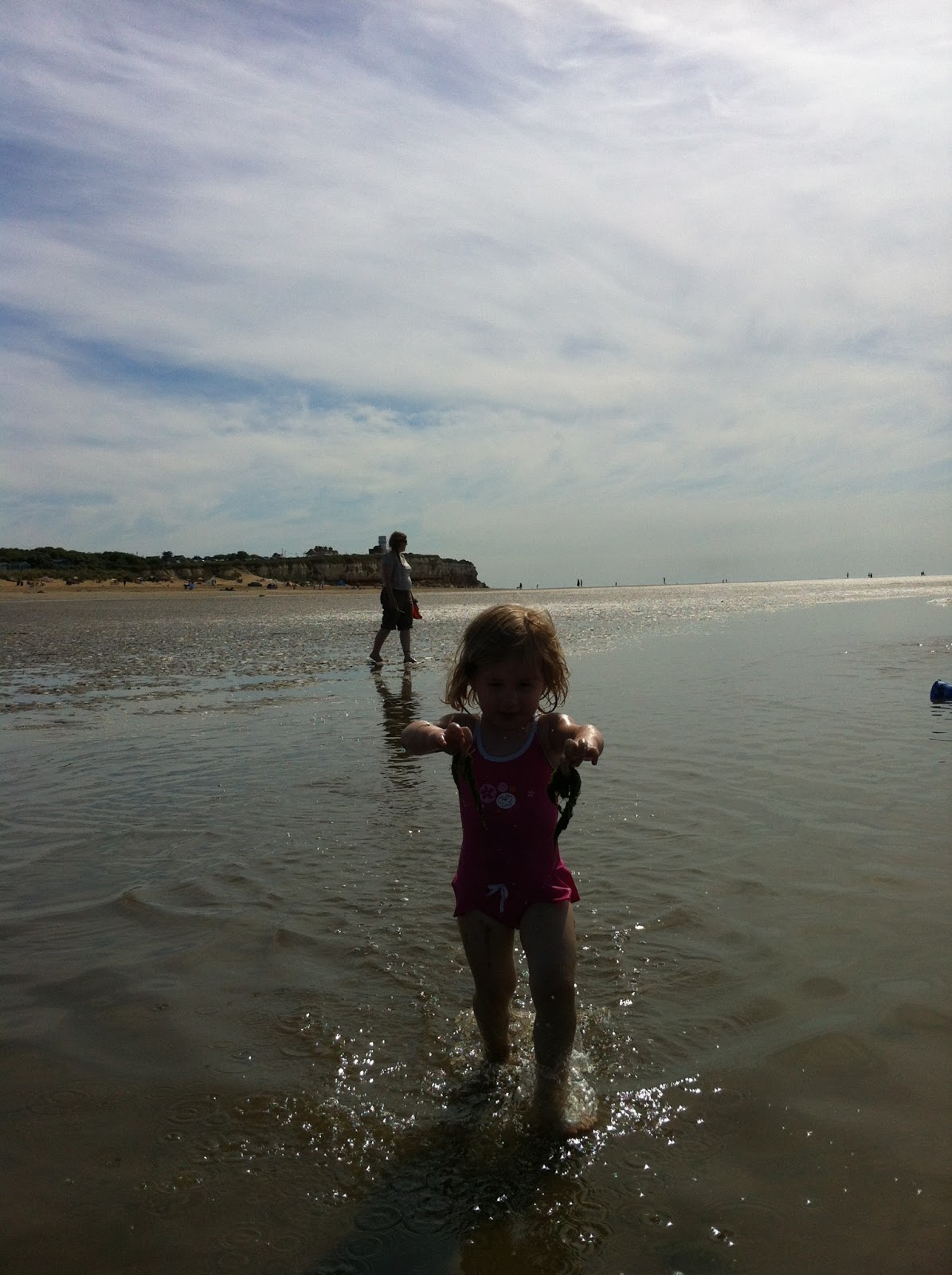
Look at the feet rushing through water, sqealching deep into mud! Love!


I want meaning. I want neatly tied up endings and clean skirting boards. I want coherence in my cupboards, and I don't even know the deep reason why I want these things. They are the coping strategies of a caged bird. 
 Yet God blesses me with complexity, paradox and silence. A work that falls apart in my hands.
It seems to me a message in a bottle, saying leave these tangled threads of past and future and all the ideas of what being good enough means. Just sit on the ragged shore of now. 
Though the fragments still don't form a picture that I can make sense of, there is a beauty in their broken form. Shards of sunlight, reflect from each facet.
And I can feel the warm breath of the sun on my face.

“The success of love is in the loving - it is not in the result of loving"

Mother Teresa 


Message from Home

Do you remember, when you were first a child.
Nothing in the world seemed strange to you?
You perceived, for the first time, shapes already familiar,
And seeing, you knew that you have always known
The lichen on the rock, fern-leaves, the flowers of thyme,
As if the elements newly met in your body,
Caught up into the momentary vortex of your living
Still kept the knowledge of a former state,
In you retained recollection of cloud and ocean,
The branching tree, the dancing flame.

Now when nature’s darkness seems strange to you,
And you walk, an alien, in the streets of cities,
Remember earth breathed you into her with the air, with the sun’s rays,
Laid you in her waters asleep, to dream
With the brown trout among the milfoil roots,
From substance of star and ocean fashioned you,
At the same source conceived you
As sun and foliage, fish and stream

Of all created things the source is one,
Simple, single as love; remember
The cell and seed of life, the sphere
That is, of child, white bird, and small blue dragon-fly
Green fern, and the gold four-petalled tormentilla
The ultimate memory.
Each latent cell puts out a future,
Unfolds its differing complexity.
As a tree puts forth leaves, and spins a fate
Fern-traced, bird-feathered, or fish-scaled.
Moss spreads its green film on the moist peat,
The germ of dragon-fly pulses into animation and takes wing
As the water-lily from the mud ascends on its ropy stem
To open a sweet white calyx to the sky.
Man, with farther to travel from his simplicity,
From the archaic moss, fish, and lily parts,
And into exile travels his long way.

As you leave Eden behind you, remember your home,
For as you remember back into your own being
You will not be alone; the first to greet you
Will be those children playing by the burn,
The otters will swim up to you in the bay,
The wild deer on the moor will run beside you.
Recollect more deeply, and the birds will come,
Fish rise to meet you in their silver shoals,
And darker, stranger, more mysterious lives
Will throng about you at the source
Where the tree’s deepest roots drink from the abyss.
Nothing in that abyss is alien to you.
Sleep at the tree’s root, where the night is spun
Into the stuff of worlds, listen to the winds,
The tides, and the night’s harmonies, and know
All that you knew before you began to forget,
Before you became estranged from your own being,
Before you had too long parted from those other
More simple children, who have stayed at home
In meadow and island and forest, in sea and river.
Earth sends a mother’s love after her exiled son,
Entrusting her message to the light and the air,
The wind and waves that carry your ship, the rain that falls,
The birds that call to you, and all the shoals
That swim in the natal waters of her ocean.
Kathleen Raine.

Sharing with Imperfect Prose

Thursday, 18 July 2013

Are we Connected?

Elder Thaddeus offers this observation:
Everything, both good and evil, comes from our thoughts. Our thoughts become reality. Even today we can see that all of creation, everything that exists on the earth and in the cosmos, is nothing but Divine thought made material in time and space. We humans were created in the image of God. Mankind was given a great gift, but we hardly understand that. God’s energy and life is in us, but we do not realize it. Neither do we understand that we greatly influence others with our thoughts. We can be very good or very evil, depending on the kind of thoughts and desires we breed. If our thoughts are kind, peaceful, and quiet, turned only toward good, then we also influence ourselves and radiate peace all around us—in our family, in the whole country, everywhere. This is true not only here on earth, but in the cosmos as well. When we labor in the fields of the Lord, we create harmony. Divine harmony, peace, and quiet spread everywhere. However, when we breed negative thoughts, that is a great evil. When there is evil in us, we radiate it among our family members and wherever we go. So you see, we can be very good or very evil. If that’s the way it is, it is certainly better to choose good! Destructive thoughts destroy the stillness within, and then we have no peace.

Our Thoughts Determine Our Lives: the Life and Teachings of Elder Thaddeus of Vitovnica (Kindle Locations 615-623). St. Herman of Alaska Brotherhood. Kindle Edition.
 spotted within a fabulous post: Are We Connected on Glory to God for All Things!

...And  Christ is in Our Midst!

Tuesday, 16 July 2013

The Happy Prince


From The Happy Prince and Other Tales by Oscar Wilde (1888)


High above the city, on a tall column, stood the statue of the Happy Prince. He was gilded all over with thin leaves of fine gold, for eyes he had two bright sapphires, and a large red ruby glowed on his sword-hilt.

He was very much admired indeed. "He is as beautiful as a weathercock," remarked one of the Town Councillors who wished to gain a reputation for having artistic tastes; "only not quite so useful," he added, fearing lest people should think him unpractical, which he really was not.

"Why can't you be like the Happy Prince?" asked a sensible mother of her little boy who was crying for the moon. "The Happy Prince never dreams of crying for anything."

"I am glad there is someone in the world who is quite happy," muttered a disappointed man as he gazed at the wonderful statue.

"He looks just like an angel," said the Charity Children as they came out of the cathedral in their bright scarlet cloaks and their clean white pinafores.

"How do you know?" said the Mathematical Master, "you have never seen one."

"Ah! but we have, in our dreams," answered the children; and the Mathematical Master frowned and looked very severe, for he did not approve of children dreaming.

One night there flew over the city a little Swallow. His friends had gone away to Egypt six weeks before, but he had stayed behind, for he was in love with the most beautiful Reed. He had met her early in the spring as he was flying down the river after a big yellow moth, and had been so attracted by her slender waist that he had stopped to talk to her.

"Shall I love you?" said the Swallow, who liked to come to the point at once, and the Reed made him a low bow. So he flew round and round her, touching the water with his wings, and making silver ripples. This was his courtship, and it lasted all through the summer.

"It is a ridiculous attachment," twittered the other Swallows; "she has no money, and far too many relations"; and indeed the river was quite full of Reeds. Then, when the autumn came they all flew away.

After they had gone he felt lonely, and began to tire of his lady- love. "She has no conversation," he said, "and I am afraid that she is a coquette, for she is always flirting with the wind." And certainly, whenever the wind blew, the Reed made the most graceful curtseys. "I admit that she is domestic," he continued, "but I love travelling, and my wife, consequently, should love travelling also."

"Will you come away with me?" he said finally to her; but the Reed shook her head, she was so attached to her home.

"You have been trifling with me," he cried. "I am off to the Pyramids. Good-bye!" and he flew away.

All day long he flew, and at night-time he arrived at the city. "Where shall I put up?" he said; "I hope the town has made preparations."

Then he saw the statue on the tall column.

"I will put up there," he cried; "it is a fine position, with plenty of fresh air." So he alighted just between the feet of the Happy Prince.

"I have a golden bedroom," he said softly to himself as he looked round, and he prepared to go to sleep; but just as he was putting his head under his wing a large drop of water fell on him. "What a curious thing!" he cried; "there is not a single cloud in the sky, the stars are quite clear and bright, and yet it is raining. The climate in the north of Europe is really dreadful. The Reed used to like the rain, but that was merely her selfishness."

Then another drop fell.

"What is the use of a statue if it cannot keep the rain off?" he said; "I must look for a good chimney-pot," and he determined to fly away.

But before he had opened his wings, a third drop fell, and he looked up, and saw - Ah! what did he see?

The eyes of the Happy Prince were filled with tears, and tears were running down his golden cheeks. His face was so beautiful in the moonlight that the little Swallow was filled with pity.

"Who are you?" he said.

"I am the Happy Prince."

"Why are you weeping then?" asked the Swallow; "you have quite drenched me."

"When I was alive and had a human heart," answered the statue, "I did not know what tears were, for I lived in the Palace of Sans- Souci, where sorrow is not allowed to enter. In the daytime I played with my companions in the garden, and in the evening I led the dance in the Great Hall. Round the garden ran a very lofty wall, but I never cared to ask what lay beyond it, everything about me was so beautiful. My courtiers called me the Happy Prince, and happy indeed I was, if pleasure be happiness. So I lived, and so I died. And now that I am dead they have set me up here so high that I can see all the ugliness and all the misery of my city, and though my heart is made of lead yet I cannot chose but weep."

"What! is he not solid gold?" said the Swallow to himself. He was too polite to make any personal remarks out loud.

"Far away," continued the statue in a low musical voice, "far away in a little street there is a poor house. One of the windows is open, and through it I can see a woman seated at a table. Her face is thin and worn, and she has coarse, red hands, all pricked by the needle, for she is a seamstress. She is embroidering passion- flowers on a satin gown for the loveliest of the Queen's maids-of- honour to wear at the next Court-ball. In a bed in the corner of the room her little boy is lying ill. He has a fever, and is asking for oranges. His mother has nothing to give him but river water, so he is crying. Swallow, Swallow, little Swallow, will you not bring her the ruby out of my sword-hilt? My feet are fastened to this pedestal and I cannot move."

"I am waited for in Egypt," said the Swallow. "My friends are flying up and down the Nile, and talking to the large lotus- flowers. Soon they will go to sleep in the tomb of the great King. The King is there himself in his painted coffin. He is wrapped in yellow linen, and embalmed with spices. Round his neck is a chain of pale green jade, and his hands are like withered leaves."

"Swallow, Swallow, little Swallow," said the Prince, "will you not stay with me for one night, and be my messenger? The boy is so thirsty, and the mother so sad."

"I don't think I like boys," answered the Swallow. "Last summer, when I was staying on the river, there were two rude boys, the miller's sons, who were always throwing stones at me. They never hit me, of course; we swallows fly far too well for that, and besides, I come of a family famous for its agility; but still, it was a mark of disrespect."

But the Happy Prince looked so sad that the little Swallow was sorry. "It is very cold here," he said; "but I will stay with you for one night, and be your messenger."

"Thank you, little Swallow," said the Prince.

So the Swallow picked out the great ruby from the Prince's sword, and flew away with it in his beak over the roofs of the town.

He passed by the cathedral tower, where the white marble angels were sculptured. He passed by the palace and heard the sound of dancing. A beautiful girl came out on the balcony with her lover. "How wonderful the stars are," he said to her, "and how wonderful is the power of love!"

"I hope my dress will be ready in time for the State-ball," she answered; "I have ordered passion-flowers to be embroidered on it; but the seamstresses are so lazy."

He passed over the river, and saw the lanterns hanging to the masts of the ships. He passed over the Ghetto, and saw the old Jews bargaining with each other, and weighing out money in copper scales. At last he came to the poor house and looked in. The boy was tossing feverishly on his bed, and the mother had fallen asleep, she was so tired. In he hopped, and laid the great ruby on the table beside the woman's thimble. Then he flew gently round the bed, fanning the boy's forehead with his wings. "How cool I feel," said the boy, "I must be getting better"; and he sank into a delicious slumber.

Then the Swallow flew back to the Happy Prince, and told him what he had done. "It is curious," he remarked, "but I feel quite warm now, although it is so cold."

"That is because you have done a good action," said the Prince. And the little Swallow began to think, and then he fell asleep. Thinking always made him sleepy.

When day broke he flew down to the river and had a bath. "What a remarkable phenomenon," said the Professor of Ornithology as he was passing over the bridge. "A swallow in winter!" And he wrote a long letter about it to the local newspaper. Every one quoted it, it was full of so many words that they could not understand.

"To-night I go to Egypt," said the Swallow, and he was in high spirits at the prospect. He visited all the public monuments, and sat a long time on top of the church steeple. Wherever he went the Sparrows chirruped, and said to each other, "What a distinguished stranger!" so he enjoyed himself very much.

When the moon rose he flew back to the Happy Prince. "Have you any commissions for Egypt?" he cried; "I am just starting."

"Swallow, Swallow, little Swallow," said the Prince, "will you not stay with me one night longer?"

"I am waited for in Egypt," answered the Swallow. "To-morrow my friends will fly up to the Second Cataract. The river-horse couches there among the bulrushes, and on a great granite throne sits the God Memnon. All night long he watches the stars, and when the morning star shines he utters one cry of joy, and then he is silent. At noon the yellow lions come down to the water's edge to drink. They have eyes like green beryls, and their roar is louder than the roar of the cataract.

"Swallow, Swallow, little Swallow," said the Prince, "far away across the city I see a young man in a garret. He is leaning over a desk covered with papers, and in a tumbler by his side there is a bunch of withered violets. His hair is brown and crisp, and his lips are red as a pomegranate, and he has large and dreamy eyes. He is trying to finish a play for the Director of the Theatre, but he is too cold to write any more. There is no fire in the grate, and hunger has made him faint."

"I will wait with you one night longer," said the Swallow, who really had a good heart. "Shall I take him another ruby?"

"Alas! I have no ruby now," said the Prince; "my eyes are all that I have left. They are made of rare sapphires, which were brought out of India a thousand years ago. Pluck out one of them and take it to him. He will sell it to the jeweller, and buy food and firewood, and finish his play."

"Dear Prince," said the Swallow, "I cannot do that"; and he began to weep.

"Swallow, Swallow, little Swallow," said the Prince, "do as I command you."

So the Swallow plucked out the Prince's eye, and flew away to the student's garret. It was easy enough to get in, as there was a hole in the roof. Through this he darted, and came into the room. The young man had his head buried in his hands, so he did not hear the flutter of the bird's wings, and when he looked up he found the beautiful sapphire lying on the withered violets.

"I am beginning to be appreciated," he cried; "this is from some great admirer. Now I can finish my play," and he looked quite happy.

The next day the Swallow flew down to the harbour. He sat on the mast of a large vessel and watched the sailors hauling big chests out of the hold with ropes. "Heave a-hoy!" they shouted as each chest came up. "I am going to Egypt"! cried the Swallow, but nobody minded, and when the moon rose he flew back to the Happy Prince.

"I am come to bid you good-bye," he cried.

"Swallow, Swallow, little Swallow," said the Prince, "will you not stay with me one night longer?"

"It is winter," answered the Swallow, "and the chill snow will soon be here. In Egypt the sun is warm on the green palm-trees, and the crocodiles lie in the mud and look lazily about them. My companions are building a nest in the Temple of Baalbec, and the pink and white doves are watching them, and cooing to each other. Dear Prince, I must leave you, but I will never forget you, and next spring I will bring you back two beautiful jewels in place of those you have given away. The ruby shall be redder than a red rose, and the sapphire shall be as blue as the great sea."

"In the square below," said the Happy Prince, "there stands a little match-girl. She has let her matches fall in the gutter, and they are all spoiled. Her father will beat her if she does not bring home some money, and she is crying. She has no shoes or stockings, and her little head is bare. Pluck out my other eye, and give it to her, and her father will not beat her."

"I will stay with you one night longer," said the Swallow, "but I cannot pluck out your eye. You would be quite blind then."

"Swallow, Swallow, little Swallow," said the Prince, "do as I command you."

So he plucked out the Prince's other eye, and darted down with it. He swooped past the match-girl, and slipped the jewel into the palm of her hand. "What a lovely bit of glass," cried the little girl; and she ran home, laughing.

Then the Swallow came back to the Prince. "You are blind now," he said, "so I will stay with you always."

"No, little Swallow," said the poor Prince, "you must go away to Egypt."

"I will stay with you always," said the Swallow, and he slept at the Prince's feet.

All the next day he sat on the Prince's shoulder, and told him stories of what he had seen in strange lands. He told him of the red ibises, who stand in long rows on the banks of the Nile, and catch gold-fish in their beaks; of the Sphinx, who is as old as the world itself, and lives in the desert, and knows everything; of the merchants, who walk slowly by the side of their camels, and carry amber beads in their hands; of the King of the Mountains of the Moon, who is as black as ebony, and worships a large crystal; of the great green snake that sleeps in a palm-tree, and has twenty priests to feed it with honey-cakes; and of the pygmies who sail over a big lake on large flat leaves, and are always at war with the butterflies.

"Dear little Swallow," said the Prince, "you tell me of marvellous things, but more marvellous than anything is the suffering of men and of women. There is no Mystery so great as Misery. Fly over my city, little Swallow, and tell me what you see there."

So the Swallow flew over the great city, and saw the rich making merry in their beautiful houses, while the beggars were sitting at the gates. He flew into dark lanes, and saw the white faces of starving children looking out listlessly at the black streets. Under the archway of a bridge two little boys were lying in one another's arms to try and keep themselves warm. "How hungry we are!" they said. "You must not lie here," shouted the Watchman, and they wandered out into the rain.

Then he flew back and told the Prince what he had seen.

"I am covered with fine gold," said the Prince, "you must take it off, leaf by leaf, and give it to my poor; the living always think that gold can make them happy."

Leaf after leaf of the fine gold the Swallow picked off, till the Happy Prince looked quite dull and grey. Leaf after leaf of the fine gold he brought to the poor, and the children's faces grew rosier, and they laughed and played games in the street. "We have bread now!" they cried.

Then the snow came, and after the snow came the frost. The streets looked as if they were made of silver, they were so bright and glistening; long icicles like crystal daggers hung down from the eaves of the houses, everybody went about in furs, and the little boys wore scarlet caps and skated on the ice.

The poor little Swallow grew colder and colder, but he would not leave the Prince, he loved him too well. He picked up crumbs outside the baker's door when the baker was not looking and tried to keep himself warm by flapping his wings.

But at last he knew that he was going to die. He had just strength to fly up to the Prince's shoulder once more. "Good-bye, dear Prince!" he murmured, "will you let me kiss your hand?"

"I am glad that you are going to Egypt at last, little Swallow," said the Prince, "you have stayed too long here; but you must kiss me on the lips, for I love you."

"It is not to Egypt that I am going," said the Swallow. "I am going to the House of Death. Death is the brother of Sleep, is he not?"

And he kissed the Happy Prince on the lips, and fell down dead at his feet.

At that moment a curious crack sounded inside the statue, as if something had broken. The fact is that the leaden heart had snapped right in two. It certainly was a dreadfully hard frost.

Early the next morning the Mayor was walking in the square below in company with the Town Councillors. As they passed the column he looked up at the statue: "Dear me! how shabby the Happy Prince looks!" he said.

"How shabby indeed!" cried the Town Councillors, who always agreed with the Mayor; and they went up to look at it.

"The ruby has fallen out of his sword, his eyes are gone, and he is golden no longer," said the Mayor in fact, "he is litttle beter than a beggar!"

"Little better than a beggar," said the Town Councillors.

"And here is actually a dead bird at his feet!" continued the Mayor. "We must really issue a proclamation that birds are not to be allowed to die here." And the Town Clerk made a note of the suggestion.

So they pulled down the statue of the Happy Prince. "As he is no longer beautiful he is no longer useful," said the Art Professor at the University.

Then they melted the statue in a furnace, and the Mayor held a meeting of the Corporation to decide what was to be done with the metal. "We must have another statue, of course," he said, "and it shall be a statue of myself."

"Of myself," said each of the Town Councillors, and they quarrelled. When I last heard of them they were quarrelling still.

"What a strange thing!" said the overseer of the workmen at the foundry. "This broken lead heart will not melt in the furnace. We must throw it away." So they threw it on a dust-heap where the dead Swallow was also lying.

"Bring me the two most precious things in the city," said God to one of His Angels; and the Angel brought Him the leaden heart and the dead bird.

"You have rightly chosen," said God, "for in my garden of Paradise this little bird shall sing for evermore, and in my city of gold the Happy Prince shall praise me."


THE END.

       *      *      *      *      *      *      *       *       *       *

Friday, 12 July 2013

Mud, Freedom and the Poetry of John Clare

4580
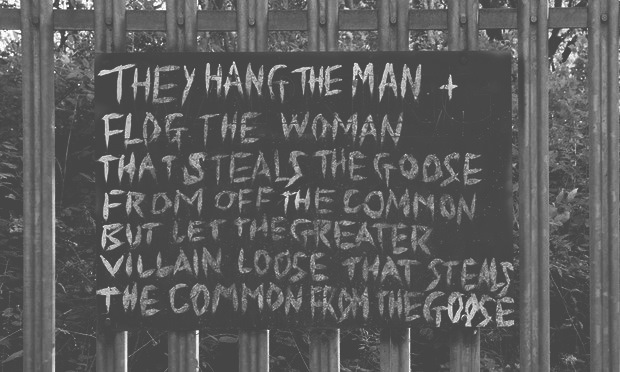
A poem painted on a defaced ‘no trespassing’ sign at Freeman’s Wood. Photograph: Bradley L Garrett
The Enclosures were a series of United Kingdom Acts of Parliament which enclosed open fields and common land in the country, creating legal property rights to land that was previously considered common. Between 1604 and 1914, over 5,200 individual Enclosure Acts were put into place, enclosing 6.8 million acres.

Prior to the enclosures in England, a portion of the land was categorized as “common” or “waste”. “Common” land was under some kind of collective control. Called the open field system, a single plot of land was divided among groups, often a lord and employed or participating peasants. This facilitated common grazing and crop rotation.”Waste” was the only land not officially claimed by any group, often cultivated by landless peasants.
*
In her book about the wonder of childhood “Kith,” Jay Griffiths writes about the effects the Enclosures had on ordinary people.
“It is hard today to imagine what children’s lives were like before the Enclosures and it is impossible to overstate the terrible, lasting alteration which those Acts made to childhood in Britain.
Although it is not, in the great scheme of things, so very long ago, we today are effectively fenced off from even its memory.“…
” The commons was home for boy or bird but the Enclosures stole the nests of both, bereaved children of the site of their childhood, robbed them of animal- tutors and river- mentors and stole their deep dream – shelter. The great outdoors was fenced off and marked “TRESPASSERS WILL BE PROSECUTED.“…
” Over the generations, as the outdoors shrank, the indoor world enlarged in importance.“…
*
Before the Enclosures commons and heaths were essentially a shared resource where the poor could keep a cow, gather fallen branches for firewood, plant crops and hunt.
These were also the places of ancient carnival, traditional festival and children’s free play. The enclosures transformed this cultural heritage and had a deep, haunting effect on the psyche of the pastoral poet John Clare.
*
” The Enclosures threw the peasantry into that acute poverty which would scar Clare’s own life and mind so deeply. His grief stricken madness, alcoholism and exile as a result of this land – loss encapsulates in one indigenous life the experience of so many indigenous cultures.“…
” By 1816, poachers, including children of nine or ten, were given punishments of imprisonment or transportation of offences against the Games Laws, enacted to protect the hunting rights of the wealthy.”…” “The games of the gentry – hunting for fun – were fiercely protect, while hunting for sheer starving necessity, engaged in by children and adults was outlawed.”
…” The 1794 Report on Enclosures in Shropshire states with nasty approval that a result of the Enclosures would be that ” the labourers will work every day in the year, their children will be put out to labour early.” Children’s hard labour would become necessary for survival as families lost one right after another, including gleaners rights to leaze after the harvest.”
Griffiths continues…. ” I  have been with Amazonian people when they have seen the searing brutality of their lands being ripped apart for gold in today’s act of corporate enclosure, and I  have watched men weep while they say aghast, ” We are the land,” a truth which John Clare would have effortlessly understood.”
*
Governments often legislate in favour of  corporations and private enterprises giving them mandates to compromise the well being of the natural environment and the local communities that work and live in them to make a profit. From local battle grounds such as Freeman’s Wood to the contravening of treaty laws which allow the continuation of the Dakota pipeline, from fracking to the wholesale expulsion of tribal communities from the Amazon, there are many contemporary examples of this.
More and more of the natural world is being patented, privatized and fenced off from children and adults alike. As a result birthrights such as clean water, air and the freedom to roam are slowly becoming commodities sold for profit.
The poem below is by John Clare. To me it is a wild cry of the land for its children and the children for their birthright, the land. It rings with the call of the warbler for its secret nest among the pines and the fox’s silent plea to the hunter’s horn. It resonates with that deep longing we carry for re-connection with  our natural human and humane state,honest as the trees, animals and dark skinned earth; our home. It is the yearning to live free of laws made to enlarge the estates of an elite few as the many lose their access to the land.
The Elm tree of the poem was felled during the Enclosures. From it a carpenter friend of Clare’s, fashioned a wooden ruler as a keepsake and symbol of the value of measured gain over incalculable loss.
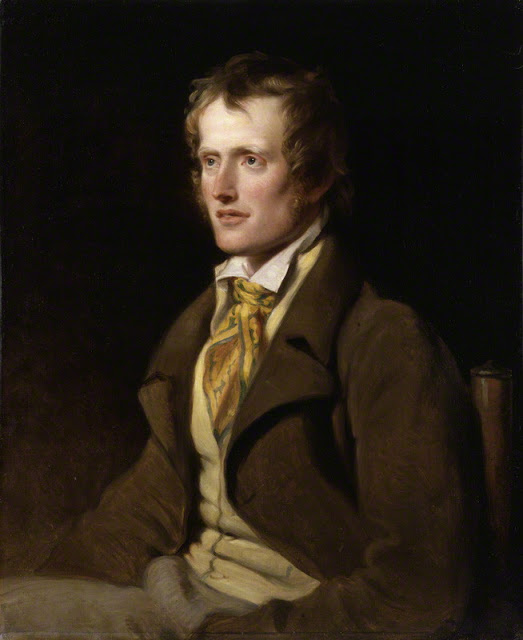
by William Hilton, oil on canvas, 1820
To a Fallen Elm
Old Elm that murmured in our chimney top
The sweetest anthem autumn ever made
And into mellow whispering calms would drop
When showers fell on thy many coloured shade
And when dark tempests mimic thunder made
While darkness came as it would strangle light
With the black tempest of a winter night
That rocked thee like a cradle to thy root
How did I love to hear the winds upbraid
Thy strength without while all within was mute
It seasoned comfort to our hearts desire
We felt thy kind protection like a friend
And pitched our chairs up closer to the fire
Enjoying comforts that was was never penned
Old favourite tree thoust seen times changes lower
But change till now did never come to thee
For time beheld thee as his sacred dower
And nature claimed thee her domestic tree
Storms came and shook thee with aliving power
Yet steadfast to thy home thy roots hath been
Summers of thirst parched round thy homely bower
Till earth grew iron – still thy leaves was green
The children sought thee in thy summer shade
And made their play house rings of sticks and stone
The mavis sang and felt himself alone
While in they leaves his early nest was made
And I did feel his happiness mine own
Nought heeding that our friendship was betrayed
Friend not inanimate- tho stocks and stones
There are and many cloathed in flesh and bones
Thou ownd a language by which hearts are stirred
Deeper than by the attribute of words
Thine spoke a feeling known in every tongue
Language of pity and the force of wrong
What cant assumes what hypocrites may dare
Speaks home to truth and shows it what they are
I see a picture that thy fate displays
And learn a lesson from thy destiny
Self interest saw thee stand in freedoms ways
So thy old shadow must a tyrant be
Thoust heard the knave abusing those in power
Bawl freedom loud and then oppress the free
Thoust sheltered hypocrites in many an hour
That when in power would never shelter thee
Thoust heard the knave supply his canting powers
With wrongs illusions when he wanted friends
That bawled for shelter when he lived in showers
And when clouds vanished made thy shade amends
With axe at root he felled thee to the ground
And barked of freedom – O I hate that sound
It grows the cant terms of enslaving tools
To wrong another by the name of right
It grows a licence with oer bearing fools
To cheat plain honesty by force of might
Thus came enclosure- ruin was her guide
But freedoms clapping hands enjoyed the sight
Tho comforts cottage soon was thrust aside
And workhouse prisons raised upon the site
Een natures dwelling far away from men
The common heath became the spoilers prey
The rabbit had not where to make his den
And labours only cow was drove away
No matter- wrong was right and right was wrong
And freedoms brawl was sanction to the song
Such was thy ruin music making Elm
The rights of freedom was to injure thine
As thou wert served so would they overwhelm
In freedoms name the little so would they over whelm
And these are knaves that brawl for better laws
And cant of tyranny in stronger powers
Who glut their vile unsatiated maws
And freedoms birthright from the weak devours.


.

.

.

{this moment}

Joining Soulemama today for {This Moment}
{this moment} - A Friday ritual. A single photo - no words - capturing a moment from the week. A simple, special, extraordinary moment. A moment I want to pause, savor and remember.


Thursday, 11 July 2013

A Birthday tea for Granny


Emmy crocheted this flower brooch for Granny


Fifi tells granny all about her beloved doll Daisy's latest adventures

Fina came with me on a shopping expedition this morning to find some special presents for Granny. She chose a pretty butterfly card, a pot of homemade Scottish blackcurrant preserve and  kept asking when it would be her birthday at the sweet counter.
I wondered  if we might do even better than a pot of jam (lovely though it was) so she gleefully took me on a tour of some very precariously balanced and astonishingly pricey china mugs, pointing with very pointy fingers at the ones right at the tippedy top of the display. We finally settled on some gourmet fudge, a box of biscuits, and a lovely flowering pot plant which I have forgotten the name of.
I got a bit carried away looking at roses and almost lugged a 5 foot tall heirloom variety rose named "Alexandra" all the way home without much consideration of how that might work in real terms. It was heirloom, is was rambling, it was sunsets and romance! I couldn't help myself.
Fina (who is quite a reliable reality checker :)  realised where this was all going and stamped her foot  in exclamation, asking "but when are we going to get out of here?"
The quiet, elderly couples perusing the lavender beds nodded politely, a couple smiled. It always seems so extra quiet during term times for families with 5 chattering girls (1 Fina can equal 5 :) Especially 5 girls who don't always follow conventional etiquette on volume control. These moments are often followed by a well meaning "have they got a day off school today?"
 I sometimes just say yes :)
Our girls can be endlessly chattery and expressive in all emotional directions but they are also a very friendly bunch so most people they come across tend to end up somewhat enamoured with them. :) They are also happy to talk to almost anyone at the drop of a hat about almost any subject and they absolutely love to play with younger children and give cuddles to the ladies at church.
I sometimes imagine the crazy that comes along with us puts other parents at ease. There is no time for being concerned with appearances with a gaggle about you. Which, I suppose, is a perk of being too worn out to worry what others might be thinking :)
I really want to spend more one on one trips out with Fina. Being the "piggly in the miggly" and incredible independent I often find I leave her to her own pursuits a little more than I do the others. Also there is the efficiency of doing things as a group rather than one by one. However, I think this approach works better when they're little. Now they are blossoming into unique characters with unique desires and interests it is often better for me to divide myself between them rather than present a project en masse.
I am so happy when their Granny is well enough to visit. As with many young families, we don't have a support system of family, community and elders around us so together we try to take these roles on for our children. Granny is a beautiful link with an older generation but sadly, as her health wanes she often has little strength for visits.  Elders are such a jewel in the lives of children and families. I see the way the children light up around her, trying to make her comfortable, entertain her with stories and jokes and cuddle up to her.
We need kind, wise older people to be there in supporting and loving roles for our children and families. Children instinctively love old people because their worldly masks, which they have know use for anymore, have been discarded and if they've done their soul work, in their place, shines a warm humble honesty and a sure smile. I've recently been reading "Sibling Society" by Robert Bly  which keenly narrates the decline of wise elders and initiates in Western society.  I look forward to the day when I am able to offer support and love to a young mother or a  young family who is in need of it. I hope I'll grow to have the wisdom for such a role. Maybe all the mistakes, revisions and resolutions I make along the way are good training ground for that  :)
Fina is an old soul. I have learnt more about myself parenting her than I have any other child. We had much fun together yesterday.
She relished playing crocodile catch down the slide today and showing me her circus tricks on the small wooden playground at the fruit farm where we stopped for a quick bite to eat.
Although she puts on a brave front, she can get easily frightened and is very sensitive.
She got upset with me when I pretended to catch her doll playing crocodiles. I realised my mistake right away (her doll is so close to her own feelings). I promised I wouldn't so it again and when I proved my word  true she nearly knocked me over with her hug. This is Fina, a force, an energy field. She sparkles.
When we got home she was excited to help get everything ready for Granny's tea and drew about ten pictures for her.
They all love chattering away to Granny, telling her stories and asking her questions.
Nola enjoyed having a legitimate reason for picking off a bunch of borage flower heads to decorate her cake with. She meandered about, as she pleased, running in and out of the garden and all about the house with muddy feet as she seems to be allergic to shoes at the moment. With so many eyes and arms to shelter her she has the freest rein of any child thus far. 
Granny hardly got a word in edgewise this afternoon, but I wonder that her enjoyment was none the worse for that.