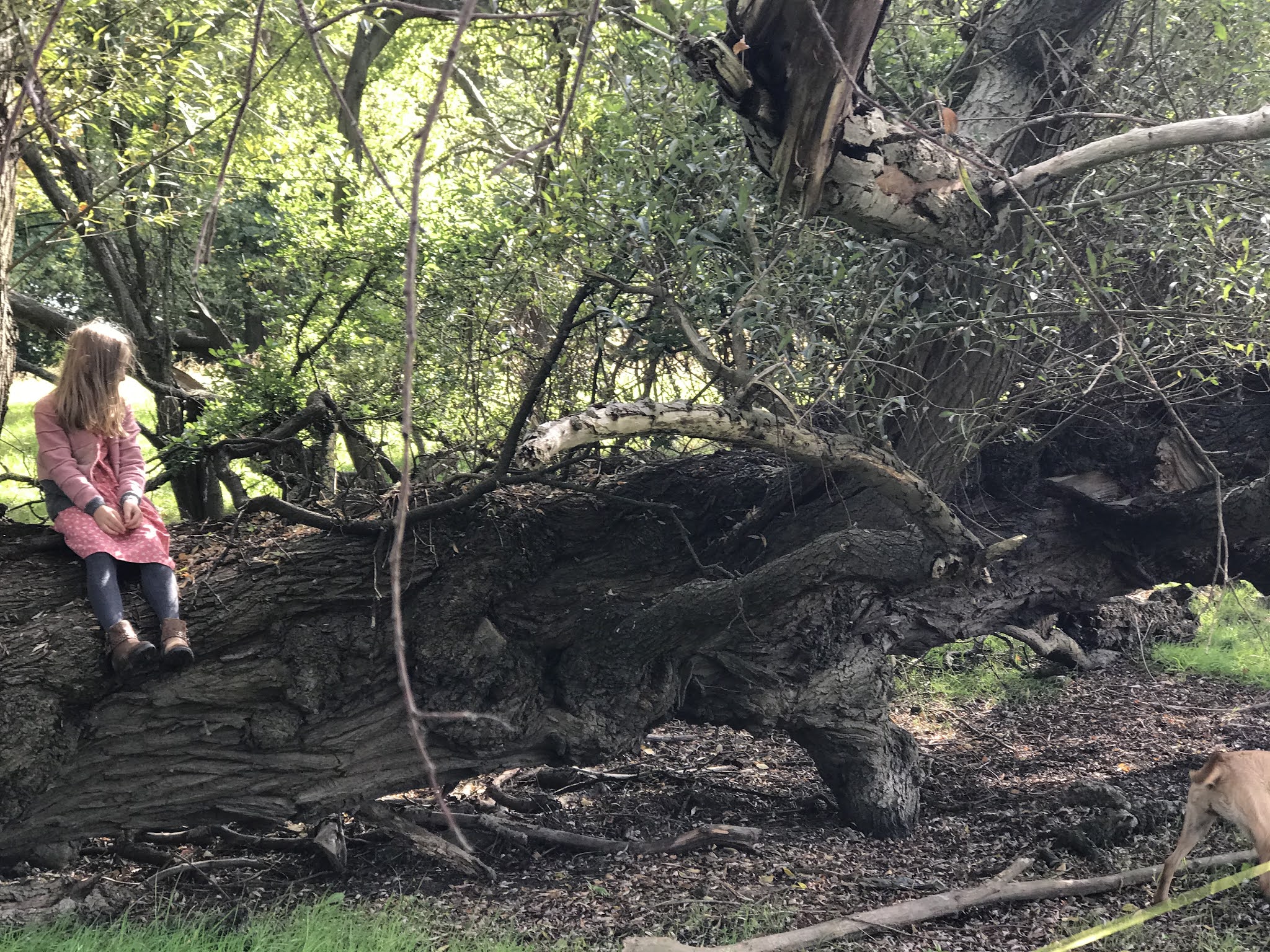
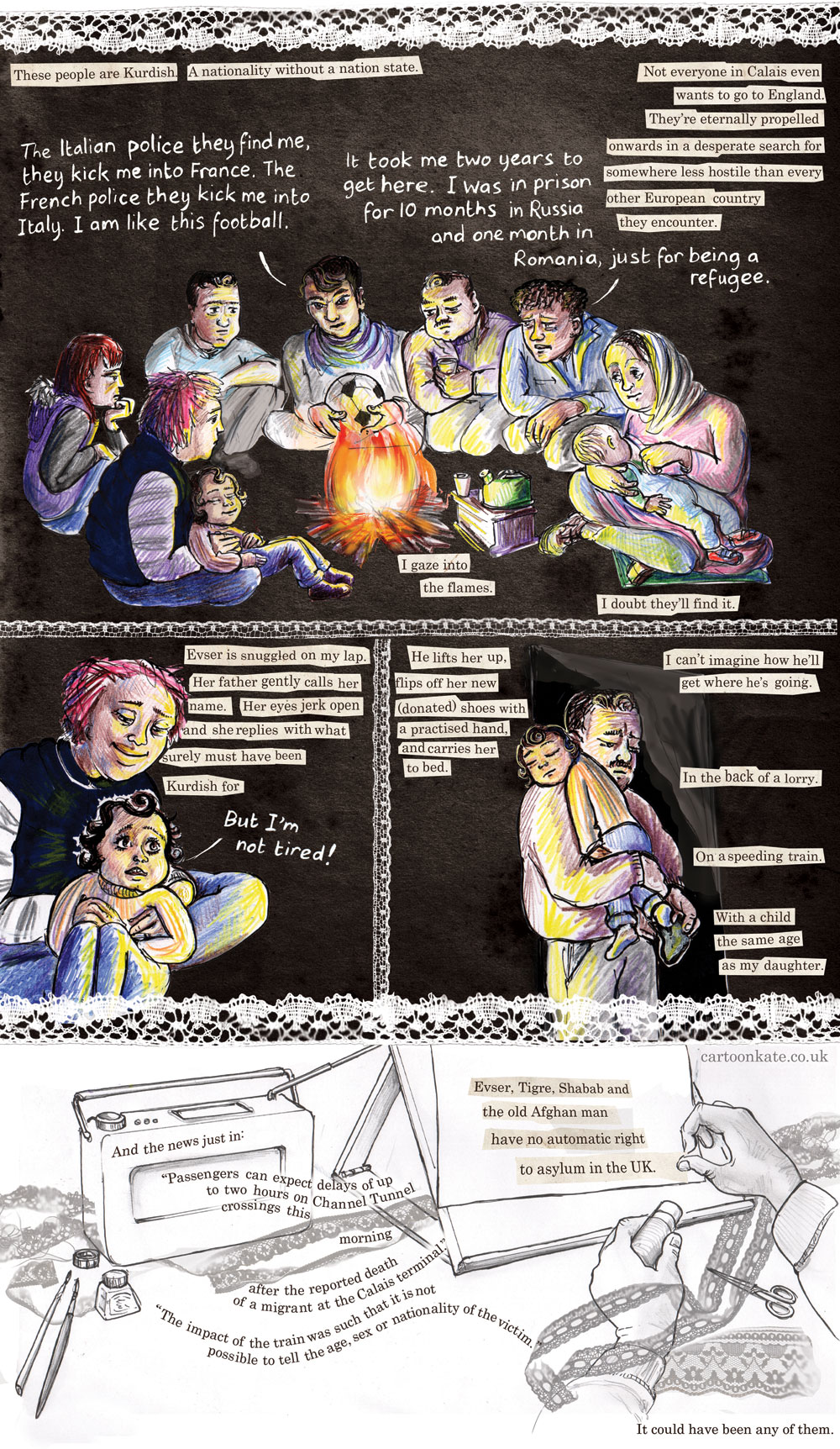
In a perceived ‘middle class’ context, the sight of children creating, building, getting mucky, and congregating in groups to play boisterously is encouraged. Yet how differently perceived are children engaging in the same activities with limited resources in a ‘working class’ context such as a council estate. Something to think about.
‘The stigma attached to poverty and low incomes begins early in childhood. When children make dens in parent-funded woodland sessions, their play is valued, encouraged and understood as a part of their development. The same natural play on a housing estate can be viewed as anti-social behaviour, and children’s dens are dismantled and disposed of.’
This morning, as I was scrolling through my YouTube feed, I came across this story from the channel ‘ Invisible People.’
One of the commenters said that if something like this happened to them it would be their own fault for not saving enough for their own retirement. This comment just made me so sad. Sad that we humans so often immediately imagine the worst of each other.
The truth is a lot of people in this day and age simply can’t save. They don’t bring in a living wage to cover their immediate expenses let alone extra to put into a savings account.
Some of these people may have been carers for family members during much of their adult lives and were therefore unable to be in paid employment long enough to save an adequate pension.
Perhaps they were left disabled through illness or injury and therefore couldn’t work enough to save.
You never know what people’s circumstances may be. Always assume the best. Most people are trying their best.
Over the last twenty years in the UK, and perhaps the US as well, the cost of living has risen and the average salary has not risen with it.
Life is different than it was years ago. I remember when an average one wage family could afford a decent home, car and an annual holiday as well as save towards retirement etc… These days people often work more than one job and still can’t pay for those things.
And even if some people simply don’t make it in life, simply can’t make it because of trauma or coming out of abusive situations, or the state of their mental/ spiritual health, or limited ability, we need to be compassionate. Some people can’t just be fixed at the click of our fingers. Because of past trauma or abuse, or mental/ spiritual health or limited abilities, some people actually need continual help and support to hobble through their lives. They simply cannot do it on there own. And in a compassionate society that should be okay. We should be there for them.
In fact, if our society was more compassionate and valued the human soul more than the bottom line, perhaps we wouldn’t have so many casualty’s of the system. Perhaps, we wouldn’t have so many humans living in their cars in the first place.
Work is important. But a certain kind of overwork that has become so prevalent and celebrated in our culture is destructive rather than creative.
Homeschooling high school age kids I often feel the pull to put aside true creative endeavour and things that matter most of all such as quiet times that cultivate our connection to each other and God in order to press on towards ticking off an ever increasing and impossible check list.
Perhaps what I’m saying is there are many kinds of work.
The kind of work that has a marketable value may not necessarily be the most valuable work.
.
And every day, the world will drag you by the hand, yelling, “This is important! And this is important! And this is important! You need to worry about this! And this! And this!” And each day, it’s up to you to yank your hand back, put it on your heart and say, “No. This is what’s important.
Iain Thomas
.
. “Come to me, all you who are weary and burdened, and I will give you rest. Take my yoke upon you and learn from me, for I am gentle and humble in heart, and you will find rest for your souls. For my yoke is easy and my burden is light.” - Matthew 11:28-30 .
Apparently scientists can trace the DNA of every 7 billion people on this planet back to two common ancestors who lived around 135,000 years ago.
Maybe this is why we all share the same basic needs, desires, dreams, hopes and fears.We all bleed red, weep salt tears and laugh at silly jokes.
It's just that strange ideas about borders, flags, nationalities, tribes, anthems and countries get in the way from time to time.
Half of my family has to pay enormous fees to send their documents halfway across the world in order to apply for a visa to visit us never knowing whether they will be denied the freedom to travel or not. Are they criminals? No they were just born in Albania.
Surely us, ordinary folk of the world who have no say in whether bombs get dropped or how the money gets divided or where the borderlines are drawn can see through the manipulation of those who seek to divide us?
Maybe we can stand on tip toes, stretch our necks and see over those walls.
Maybe we don't have to call off the rescue boats.
Maybe we are just kin who have not met before.
I gaze at my little ones asleep and safe in their warm beds. They are so innocent, tender and new to this earth. This achingly beautiful, fragile home we humans share.
Before I close my eyes for sleep I whisper a prayer for all those who have died as a result of war and violence over the last year.
Paris
Lebanon
Nigeria
Palestine
Afghanistan
Syria
Iraq
"Hail, holy Queen, Mother of mercy, our life, our sweetness and our hope. To thee do we
cry, poor banished children of Eve. To thee to we send up our sighs, mourning and weeping
in this valley of tears. Turn, then, most gracious advocate, thine eyes of mercy toward
us, and after this, our exile, show unto us the blessed fruit of thy womb, Jesus. O
clement, O loving, O sweet Virgin Mary." Salve Regina
I hear voices of fear and confusion from all sides. My Facebook feed is lit up with the political.
Those who support military action and those who don't. Those who welcome refugees and those who don't.
There is a part of me that looks at the suffering of homeless families and veterans, the failing healthcare systems, the crumbling public services and the rampant poverty at home and wonders how we can possibly open our arms to ever more desperate humans.
Yet I want to be a part of a humanity that thinks globally not nationally. I
want my children to be a part of a world that calls every child its
own, no matter what their skin tone, creed, belief system, language or
country of birth. I want love to cast out fear. I want love to win.
After all the problem is less one of adequate resources than the distribution of them.
I think of the old man carrying his only surviving grandchild across a hostile border, or a boy helping a pregnant woman off a
petrol sodden boat and think of the children who fall asleep to the sound of bombs and guns, their parents not knowing if they will wake to see another day.
There is a part of me that just wants the evil that causes such pain to
evaporate from the earth whatever the means. I want the answer to be
simple and the delivery swift. Yet there is another part of me that understands the complexity. That knows how violence can only reap violence. There is a part of me that knows that whenever a civilization or sovereign nation depends upon the death of even one little child in an act of war or oppression it undermines it's own civility and integrity.
Due to corporate, military and economic intervention by elite groups over many years, many countries across the world have been destabilized, in terms of their agricultural systems, their environment, their culture, traditions and infrastructure. Coups have been initiated puppet leaders installed and then non corrupt autonomy has expected to follow.
The kind of unfathomable horror that is isis has been perpetuated throughout history in different forms. From nazi concentration camps, to the slave ships of Africa and the ethnic cleansing of Native Tribes around the world. From the barbarianism of genghis khan to the gladiator spectacles of ancient rome. All these things were generated and initiated by elites but carried out by ordinary people, just following orders.
I pray for the oppressed no matter what their religion, race or color.
I don't know what the answers are and it seems like there is so little we can do but if ordinary people stand together and refuse to hate or be suspicious of one another then the pattern might slowly begin to change and peace might be possible again.
I realize I haven't been around much. Going from the full and crazy busy days of seven years homeschooling five children to an almost empty house during the day has left me a little dazed and bemused. I thought I'd be knee deep in all those projects I never had time for but I find myself wanting to just do simple things, wanting to fully take in the little things. There's the late afternoon sunlight after rain, grooming the cat and actually drinking a cup of tea while it's still hot. Bliss. "To be mindful is to be fully present with whatever we are doing. If you
are drinking tea, just drink your tea. Do not drink your worries, your
projects, your regrets. When you hold your cup, you may like to breathe
in, to bring your mind back to your body, stop your thinking, and become
fully present. In that moment, you become real and the cup of tea
becomes real. In this state of true presence and freedom you enjoy
simply drinking your tea." Thich Nhat Hanh Last night I dreamt that I was little again. One thing you forget about being little is how much your body wants to move and feel the elements. Water, air, earth and even fire have an irresistible appeal. You want to feel the weight of things. You want to move against their resistance and harness their power. The first thing I did in my dream of course, was jump into a really big puddle. A feet first, full on splash bomb. I could feel the mud writhing under my boots and it was delicious! There was an itch in my legs to run and climb. I stretched out my arms, feeling the width of their span like a sail against the wind as I ran down a hill. My arms felt like wings. If I lifted them up the thermals would carry me, I could feel it. At one point I began swimming like a fish in strong tidal waters. Water scares me and am not a strong swimmer so this was especially liberating. Then as the itch spread up through my arms and I found myself standing on a boat. A paddle in my hand shovelled the heavy water with satisfying ease. I watched the ripples ebb away silently. Finally I found myself on the back of a horse galloping fast and free. This dream surprised me. I have always thought of myself as a homebody. Although I enjoy walking in the countryside, I have never been keen on sports. And yet, as I dwelt on the dream I realised how much I actually did love to feel the elements on my skin. It made me remember how, when I was little I loved to move and dance and play in water. I loved to feel the bracing aliveness of testing my limitations by climbing, tumbling and rolling down hills. I began to wonder when this love and freedom of my own body ended
I remember constantly being told to sit still at school. I fidgeted a lot. I'd rock on my chair, tap my fingers on the desk, or kick my legs. Which must have driven my poor teachers to distraction in all truthfulness. Thinking on these memories I remember a sense of shame being attached to movement quite early on. Sit still, line up, don't wiggle, stay put! At the age of 5 or 6 I didn't question this of course. I also remember that it was at school that I first really realised that I was clumsy. I couldn't catch a ball and threw poorly. I was less coordinated as some other kids and me and the other ones labelled not good at sports were always last to be chosen for teams. Slowly but surely I began to mistrust my own body. Instead of enjoying my physicality, I became self conscious and more sedentary. It happened, slowly, incrementally and almost intangibly. I wonder, in hindsight, if that the part of me that loved the tactile experiential side of life was channelled into art. I loved the feel of clay, think paint and pastels, indeed any medium that I could feel in the fibres of my body as well as I could see it on the fabric of my canvas. Now that I have my own children I see with great joy, that they are confident and strong in their bodies. They climb, swim, cartwheel and run with abandon and trust. Matilda has always been similar to me in regard to coordination, and clumsiness, yet, she has never noticed a problem with it. She loves to play catch, dance, kick a football and throw a netball just as much as her sisters do. However, last week she came to me rather sadly, saying she didn't want to do PE anymore because she isn't good at it. This really broke my heart. I don't want her to feel betrayed by her body. I don't want her to feel the social pressure to conform to one, particular, narrow standard. I want her to feel centred and strong in her skin. I wonder if by overly structuring and measuring movement in the form of formal lessons we undermine some children's natural love of it particularly those children who may not measure up to the standard imposed. I wonder also, whether this issue effects girls in particular. As women we often feel that we have to control our bodies, natural need for movement and play. We need to be lady like after all, right? From societies repulsion over women's natural body hair to the way female celebrities get in and out of a car, we are constantly judged, shamed, nipped and tucked into stillness and silence. Through the media we are pressured to contort our beautiful, strong, flexible feet into high heeled shoes, and make sure we look elegant in clothes that often inhibit our natural movement, comfort and freedom. Ultimately I want my girls to question the things that effect them. I want them to feel awake in their minds and strong in their bodies. I want them to be able to simply drink their tea without the pressures, conflicted interests and agendas of our competitive, consumer driven world taint the flavour.
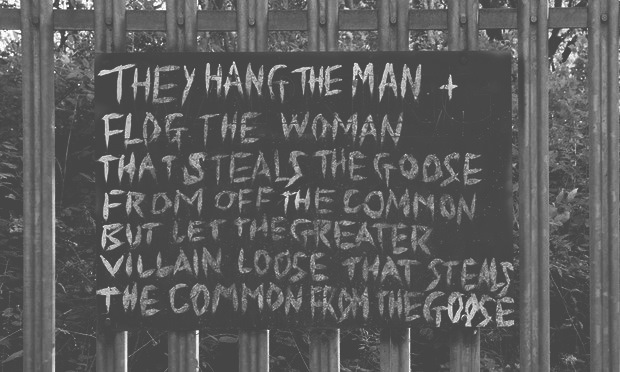
A poem painted on a defaced ‘no trespassing’ sign at Freeman’s Wood. Photograph: Bradley L GarrettThe Enclosures were a series of United Kingdom Acts of Parliament
which enclosed open fields and common land in the country, creating
legal property rights to land that was previously considered common.
Between 1604 and 1914, over 5,200 individual Enclosure Acts were put
into place, enclosing 6.8 million acres.
Prior to the enclosures in England, a portion of the land was categorized as “common”
or “waste”. “Common” land was under some kind of collective control.
Called the open field system, a single plot of land was divided among
groups, often a lord and employed or participating peasants. This
facilitated common grazing and crop rotation.”Waste” was the only land
not officially claimed by any group, often cultivated by landless
peasants.
* In her book about the wonder of childhood “Kith,” Jay Griffiths writes about the effects the Enclosures had on ordinary people.
“It is hard today to imagine what
children’s lives were like before the Enclosures and it is impossible to
overstate the terrible, lasting alteration which those Acts made to
childhood in Britain. Although it is not, in the great scheme of things, so very long ago, we today are effectively fenced off from even its memory.“…
” The commons was home for boy or bird
but the Enclosures stole the nests of both, bereaved children of the
site of their childhood, robbed them of animal- tutors and river-
mentors and stole their deep dream – shelter. The great outdoors was
fenced off and marked “TRESPASSERS WILL BE PROSECUTED.“…
” Over the generations, as the outdoors shrank, the indoor world enlarged in importance.“…
* Before the Enclosures commons and heaths were essentially a shared resource where the poor could keep a cow, gather fallen branches for firewood, plant crops and hunt.
These were also the places of ancient carnival, traditional festival and
children’s free play. The enclosures transformed this cultural heritage
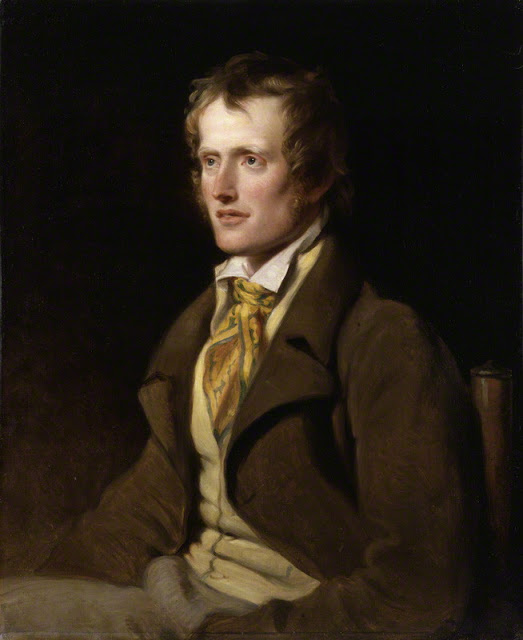
and had a deep, haunting effect on the psyche of the pastoral poet John
Clare.
*
” The Enclosures threw the peasantry into
that acute poverty which would scar Clare’s own life and mind so deeply.
His grief stricken madness, alcoholism and exile as a result of this
land – loss encapsulates in one indigenous life the experience of so
many indigenous cultures.“…
” By 1816, poachers, including children
of nine or ten, were given punishments of imprisonment or transportation
of offences against the Games Laws, enacted to protect the hunting
rights of the wealthy.”…” “The games of the gentry – hunting for fun –
were fiercely protect, while hunting for sheer starving necessity,
engaged in by children and adults was outlawed.”
…” The 1794 Report on Enclosures in
Shropshire states with nasty approval that a result of the Enclosures
would be that ” the labourers will work every day in the year, their
children will be put out to labour early.” Children’s hard labour would
become necessary for survival as families lost one right after another,
including gleaners rights to leaze after the harvest.”
Griffiths continues…. ” I have been
with Amazonian people when they have seen the searing brutality of their
lands being ripped apart for gold in today’s act of corporate
enclosure, and I have watched men weep while they say aghast, ” We are
the land,” a truth which John Clare would have effortlessly understood.”
* Governments often legislate in favour of corporations and private enterprises
giving them mandates to compromise the well being of the natural
environment and the local communities that work and live in them to make
a profit. From local battle grounds such as Freeman’s Wood to the contravening of treaty laws which allow the continuation of the Dakota pipeline, from fracking to the wholesale expulsion of tribal communities from the Amazon, there are many contemporary examples of this.
More and more of the natural world is being patented, privatized and
fenced off from children and adults alike. As a result birthrights such
as clean water, air and the freedom to roam are slowly becoming
commodities sold for profit. The poem below is by John Clare. To me it is a wild
cry of the land for its children and the children for their birthright,
the land. It rings with the call of the warbler for its secret nest
among the pines and the fox’s silent plea to the hunter’s horn. It
resonates with that deep longing we carry for re-connection with our
natural human and humane state,honest as the trees, animals and dark
skinned earth; our home. It is the yearning to live free of laws made to
enlarge the estates of an elite few as the many lose their access to
the land.
The Elm tree of the poem was felled during the Enclosures. From it a
carpenter friend of Clare’s, fashioned a wooden ruler as a keepsake and
symbol of the value of measured gain over incalculable loss. To a Fallen Elm
Old Elm that murmured in our chimney top
The sweetest anthem autumn ever made
And into mellow whispering calms would drop
When showers fell on thy many coloured shade
And when dark tempests mimic thunder made
While darkness came as it would strangle light
With the black tempest of a winter night
That rocked thee like a cradle to thy root
How did I love to hear the winds upbraid
Thy strength without while all within was mute
It seasoned comfort to our hearts desire
We felt thy kind protection like a friend
And pitched our chairs up closer to the fire
Enjoying comforts that was was never penned
Old favourite tree thoust seen times changes lower
But change till now did never come to thee
For time beheld thee as his sacred dower
And nature claimed thee her domestic tree
Storms came and shook thee with aliving power
Yet steadfast to thy home thy roots hath been
Summers of thirst parched round thy homely bower
Till earth grew iron – still thy leaves was green
The children sought thee in thy summer shade
And made their play house rings of sticks and stone
The mavis sang and felt himself alone
While in they leaves his early nest was made
And I did feel his happiness mine own
Nought heeding that our friendship was betrayed
Friend not inanimate- tho stocks and stones
There are and many cloathed in flesh and bones
Thou ownd a language by which hearts are stirred
Deeper than by the attribute of words
Thine spoke a feeling known in every tongue
Language of pity and the force of wrong
What cant assumes what hypocrites may dare
Speaks home to truth and shows it what they are
I see a picture that thy fate displays
And learn a lesson from thy destiny
Self interest saw thee stand in freedoms ways
So thy old shadow must a tyrant be
Thoust heard the knave abusing those in power
Bawl freedom loud and then oppress the free
Thoust sheltered hypocrites in many an hour
That when in power would never shelter thee
Thoust heard the knave supply his canting powers
With wrongs illusions when he wanted friends
That bawled for shelter when he lived in showers
And when clouds vanished made thy shade amends
With axe at root he felled thee to the ground
And barked of freedom – O I hate that sound
It grows the cant terms of enslaving tools
To wrong another by the name of right
It grows a licence with oer bearing fools
To cheat plain honesty by force of might
Thus came enclosure- ruin was her guide
But freedoms clapping hands enjoyed the sight
Tho comforts cottage soon was thrust aside
And workhouse prisons raised upon the site
Een natures dwelling far away from men
The common heath became the spoilers prey
The rabbit had not where to make his den
And labours only cow was drove away
No matter- wrong was right and right was wrong
And freedoms brawl was sanction to the song
Such was thy ruin music making Elm
The rights of freedom was to injure thine
As thou wert served so would they overwhelm
In freedoms name the little so would they over whelm
And these are knaves that brawl for better laws
And cant of tyranny in stronger powers
Who glut their vile unsatiated maws
And freedoms birthright from the weak devours.
These issues are really close to my heart, and I know so many other people's too.
The idea of localizing resources to create a more environmentally stable world is a really interesting idea to me.
I'm also interested in co -ops that build up local communities and bring people together on a level playing field; place where everyone's voice can be heard and appreciated.
I love the idea that we can thrive without an imposed system or hierarchy. We don't have to be dis-empowered, cogs in a wheel or passive consumers. We can all have a role that is valued and honored in our community.
We all have the right to meaningful work and a meaningful life.
Our children have a right to a warm, safe, loving community in which to grow, thrive and find their place.
One thing that really touched me about Hellena's story about her market was when she said "We were all accepted as we were,"
Reminds me a little of this wonderful speech by the wonderful and dear soul that was Mister Rogers.
This morning I watched a movie on TED called "This is Water".
It is a real contrast to the gentle, green, leafiness of Hellena's beautiful bamboo verandah isn't it :)
Do we go through the system to end up here?
... Really?
Do we see one another is such a callous way?
If so, surely something must be going somewhat wrong.
But, mostly, I'm left wondering why on earth we wouldn't question such an existence!
For this planet to begin the healing process we need to see one another, truly, deeply and with love.
It's not just our perspective that has to change.
The foundations for our perspective have to change too.
They need to be healthy, with healthy values and goals that protect our planet, our communities and our families.
I think this video illustrates that the way we are doing things now may not be conducive to that goal.
We need to start really seeing one another.
Because it's only when we really get up close, and make a real contact that we truly connect.
And it's when we connect that we can work together and truly be the change we want to see in the world.
This wasn't the post I was going to write... But as we live in the town where Margaret Thatcher grew up.... and there seems to be so much talk about her at the moment I thought it would be timely for my two cents (or tuppenny bit :) to be added to the pot :)
This is part of a comment I left at another blog, whose opinion I truly respect even though it differs from my own :)
I always like to see people before arguments. Although the argument can be an important part of forming clarity and perspective, people are so much nicer aren't they.... And so much more important than one ideology or another.
So if you're not into politics avert your gaze now :)
And if you are but you don't agree with me, God Bless you. The dissenters voice is a sign that we are all still free enough to speak our hearts while honouring the hearts of others.
I have to say that unless you are in that deep, profound rut of poverty it is very difficult to truly understand it's effect.
So many things are impacted by it. It can be very disabling and dis-empowering. I would even argue that it takes a great deal more effort to overcome an impoverished background and "rise above" than it does to maintain an affluent one.
The media has sadly begun to demonise the poor of late. It is always easier (and less complicated) to blame those socially and economically below than those above, when problems arise. Although it is becoming more and more obvious that many of the problems we face do indeed come from above; global corporations, industry, government and of course the major banks.
We live in a council house, my husband was a refugee who first landed on English soil as a teen. I was regularly homeless in London from the ages of 16 - 19 and both my parents
have suffered from mental health problems for years, so I can speak from
the "other" perspective with some clarity.
Our experience is unique, but probably quite representative of the socially disadvantaged.
We both work incredibly long hours yet still have not been able to buy our own home.
I see a lot of disillusionment where I live.
People feel disenfranchised.
Many people don't have cars and only tiny gardens or no garden at all. The houses are in a really bad state of repair, so many of the children here can't get a sense of life outside their immediate reality.
Their perspective is foreshortened.
Recent cuts to public services will most likely, only compound the problem.
It is much, much worse than this in an inner city of course.
People often blame the poor for their circumstances but surely it is much easier to make responsible choices when a wealth of choice is available to you.
Surely it is far easier to take advantage of opportunity when opportunities to learn, grow, thrive and try new experiences have been presented to you from birth.
I deeply believe that nobody is born with the ambition to live an unfulfilled, socially stigmatised, poverty stricken life. If welfare becomes your way of life, it is something to be pitied and a symptom of a problem that has a much larger cause.
The rich can also far more easily hide their problems or find monetary solutions to them.
However, I think the saddest thing is the divisions these economic discrepancies create within communities.
Our church is located right opposite Margaret Thatcher's old home.
Our town is a tenacious one, a hard working one yet, still a poor one and it is probably a fairly good example of the legacy Maggie left.
It is funny how we can be so isolated in such a busy world.
Fields are tarmacked
to make way for tennis courts
because kids can't play outside anymore.
I reach out with words; Fragile like tendrils.
Seeking a cane or a friendly fence on which to lean.
And talk about the day.
Five beings echo locate me early in the morning.
Brimming with the expectation of a new day...
Five facets, five perspectives, five ways of being and seeing.
Five little suns that need to deflect their light
through many different prisms, not only mine.
Light has a weight all it's own.
But who is there?
The streets outside seem strange and distant this morning.
People rush past in motion blur.
In the evening, I pull curtains over windows
Like cave darkened wing membranes of a sleeping bat.
I see others are camped around the warm glow
of their own screens too.
Panes of glass separated by panes of glass.
Silent, divided and contained.
Yearning for a common hearth,
A warm glow of earthy embers and friendship.
So we each reach out through ether
from the confines of our cells
to feel the life of a human touch
"A riot is the language of the unheard." Martin Luther King Jr.
After watching young voters question time this evening I just felt compelled to share my thoughts on the rioting that has taken place over many cities across the UK....
There are many avenues for blame, Parents, Schools, the Government... are but a few that have been mentioned on the news and in the papers.
Essentially above and beyond maybe any of these, may be the widening division between the social, economic and cultural facets of our communities.
Community is fragmenting.
Young people are being given no sense of belonging. No sense of future security.
Without a role in society, one that is valued, there can be no strong sense of allegiance or responsibility to that society. There is no stake. Nothing to lose. Without solid foundations of future security the transitory moment takes precedence. Long term goals are traded for short term gains.
There is certainly a growing sense of dis-empowerment and disenfranchisement in poorer communities over recent years.
The biggest voice many vulnerable young people have is as targets of amusement and bemusement on reality television shows.
Equally relevant is the clear discrepancy between how corporations, banks and politicians are treated for their crimes in comparison to the way young people from deprived backgrounds are treated. This disproportional "justice" only adds to the general feeling of disillusionment young people already have with institutions from banks to churches, to schools, to governments.
Spending on youth services, family services and children's services has been slashed since the conservative government came into power. These cuts obviously effect the poorest members of our society the most. Once again the most vulnerable are made accountable for the crimes of the powerful and elite. In lowering benefits, shortening council house tenancies, raising tuition fees... Poorer families have to extend themselves so much further just to tick the basics off the list.
We live in a rented council house and receive tax credits and although we are no way among the poorest of families I can't imagine that any of my girls will go to a traditional university. It saddens me to say this but the fees are just too high and not something we can afford. To start their lives off with huge amounts of debt is not a prospect I relish for them either, in fact it is one I hope, wholeheartedly they avoid.
But what I find most contention with is the blaming of parents.
We live in a pressure cooker of a society.... When is someone going to actually admit this!
When a young mother has to have 3 jobs to simply survive there is something going deeply wrong somewhere.
When people are mired in a lifetime of debt, simply to have the luxury of a roof over their head something is going deeply wrong somewhere.
When a family cannot raise itself without both parents working all hours so they don't even have enough time to connect with one another something is going deeply wrong somewhere.
Parents from a deprived background can't afford all the activities, resources and experiences that the wealthy can. These days with the economic pressures the struggle to find our children a place, a role, a sense of value and a reasonably comfortable seat in the assembly is running at a premium. The increasing "ghettoising" of schools and the catchment area lotteries are just one example of the pushing and shoving involved in raising children these days.
The children from deprived areas are simply born at a disadvantage. Why can no one admit this!
Families, particularly poorer families are struggling to keep up. There is little to no network of support, extended family, elders in the community... let alone anyone willing and able to take a little of the load without a fee to match the weight of it.
Everyone is simply too run off their feet to invest themselves emotionally, financially or physically in their communities. It's often hard enough to find the time for our own families at the end of a 10 hour day.
Blaming parents is easy. The problem is structural.
Our focus is off centre. Family needs to be the focus. Supporting parents, families and children should be the priority of any country.
More often than not family and childhood... in the traditional sense of what the word childhood means... are having to be sidelined in favour of simply trying to make it up the ladder. Things "Stuff" has replaced, connections, experiences and relationships.
Yes, hard work pays off and we need to give young people a sense of responsibility and accountability for their own lives but we keep them bottled up for so long and then at aged 21 expect them to suddenly "get it". Get what it takes to stand alone, without initiation, the wisdom of elders and often little to no "real life" experiences ...
When young people are pushed and shoved through every hoop and test and exam we can throw at them only to watch their hopes and dreams are dash against the ***ever rising and impossible to live up to competition*** before they have even begun... something is going deeply wrong somewhere.
When we glamorise violence in movies and video games and sanction public acts of humiliation in reality TV shows, yet expect our youth not to take their cues, something is going deeply wrong somewhere.
We say that Gordon Ramsay is allowed to vent dismaying amounts of anger, arrogance and cruelty to some unfortunate 21 year old sous chef on his first job simply because he can... Simon Cowell can extinguish a kid's love of singing his heart out in one stone cold dry sentence... Celebrities in "The Apprentice" back stab and undercut one another without a single shred of conscience.... And we can all snicker at the poor chat show "mutton dressed as lamb" ex show girl on Jerry Springer.... Yes it is all very entertaining and we are always glad it is not us at the receiving end, maybe we actually believe we are above it all.... But what is this teaching our children?
It teaches them that those that grab and grasp and claw their way to the top are life's winners. Those that back stab and fight and step on others make their dreams come true.
Those that take what they can when they can, put other's down, put the job before ethics and the rules before what is right, true, noble and good, ultimately succeed in this broken world of ours.
No the riots were not right. They were tragic, frightening and disturbing.
No there is no excuse for the violence the crowd unleashed upon the police.
Yet sadly, maybe this is illustrative of why it is so important that we get our priorities right where young people are concerned. There is a sense of meaningless for a lot of young people these days.
Ultimately they need a strength of vision. One they can really believe in. One that gives "real" not counterfeit meaning and hope to their life in this world.
Then they need the simple food of familial and community support, love and wisdom to pass it along to the generations to come.
Our children and their childhoods have got to start coming first.
I have, on occasion, been caught frozen solid in the middle of a crowded street by a glint of sunlight through the branches of a tree, or forgotten my bag on a bench to wander into a little grove of dappled light on the path ahead.
Yet beauty has become devalued in our highly industrialized world.
Everything has become streamlined to manage the practicalities of life as efficiently as possible.
The sacred journey of the geese, the lichen of every green hue imaginable upon the bark of a horse chestnut tree, and the little spider upon the quivering leaf are left unnoticed.
The mindful work of planting, growing, preparing food is replaced with convenience and empty calories.
The deep truths that speak to our very soul within the natural world are not penetrated for the sake of gleaning a breadth superficial knowledge with the questionable agenda of our mental trawling.
Art always reflects it's society.
These days even the art we see hanging out upon the walls of modern galleries has become almost utilitarian in it's aesthetic approach.
Aesthetics or beauty for beauty's sake alone is something many contemporary artists shy away from. It is not cerebral impressive, subversive or commercial enough. Or is it? I sometimes wonder if much of modern art is a case of the emperors new clothes.
Image after image, installation after installation betrays the mark of a Warhol print from his own pre fab style "factory" line productions.
Art, as many other things, has become more about image or brand than intention or integrity.
With the constant noise ... of technology buzzing around us and the demands of a life that turns upon it's dizzying axis, we have lost the ability to notice, to observe, to recognize beauty.
For economies sake houses are losing their individuality and workmanship.
Yet a thing done for nothing more than the sake of beauty is surelyvaluable indeed, within it's own right.
It's usefulness or economy should not be it's primary reason for existing.
Is it ours?
Every act of beauty is life giving.
A counter to all that is dark.
It pulls back the curtain saying
This is not the only room.
There is a garden too.
Clothed in green shoots and tender leaves.
Water it.
Life is liturgy.
And the seeking of beauty reflected in the natural world is also the seeking of the blueprint of the sacred within all things.
When we devalue the importance of beauty we are messing with the DNA that makes us both Human and humane.
Noticing, observing and recognizing beauty in the natural world around us was what the great philosopher's of the past saw as the very purpose of life.
Education and life wasn't about the repetition of tasks for the sake of both the individual and national economy, it was for the nourishment and expansion of the soul.
"Mathematicians and physicists have a habit of using the words beautiful and elegant
to endorse theories that are likelier to cleave to the nature of things
because of their efficiency and soundness of structure. I would like to
see language brought to a similar standard. If this were at all a
philosophic age, we might be wondering why it is that beauty can test
reality and solve its encryptions in the modest, yet impressive, degree
our humanity allows. For me, this is a core definition of beauty: that
it is both rigorous and dynamic and that it somehow bears a deep
relationship to truth." Marilynne Robinson
May I always be able to slow down,
...pause
and stare at the sun glinting through the shivering branches of a city tree
lifting it's leaves in praise
from the 2 by 2 sqaure patch
of dirt along the road.
For in it's way, it is becoming a symbol of us all.